
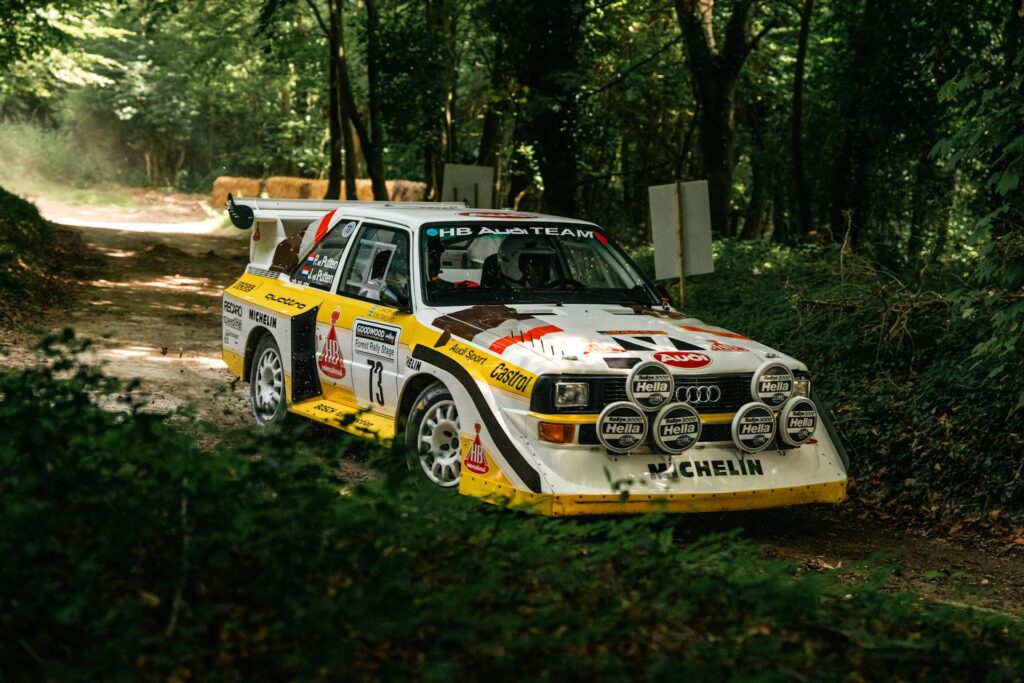
You might have heard of group B, referred to as “the golden era of rally.” There is another group that is as important as group B, but group A usually has a lower reputation than group B. These two categories represent some of the most exciting and dangerous chapters in motorsport history.
What Were Group A and Group B?
Group A and Group B were regulatory categories created by the FIA(Fédération Internationale de l’Automobile), which is an organization responsible for most of the significant motorsport competitions, like Formula 1, GT, etc., that defined what kind of cars could compete in the World Rally Championship.
Group B Era (1982-1986)
Group B era was usually called either “golden era” or “killer B’s”. In this specific era, the regulations were very weak, and the crash rates were greatly higher than those of other kinds of motorsports. Afterwards, the crashes caused the whole Group B to be banned by the FIA. Since the rules were loose, manufacturers only needed to build 200 road versions of the rally car. The number required was so low that engineers could create extremely strong, purpose-built cars without limitations and participate in the competition. From a technical perspective, the cars used in this era had an average engine size of 2 L, had an average power of 470 horsepower(varying from 410 to 550), and went 0 mph to 60 mph in 3 seconds. For comparison, the Renault Clio 1.5 dCi, a common car choice in Türkiye, has a 1.5L engine producing 90 hp and goes from 0 mph to 60 mph in 10.8 seconds. So Group B cars almost had 5-6x more power compared to regular city cars. In 1986, lots of fatal accidents happened. The final fatal crash of Henri Toivonen(pilot) and Sergio Cresto(co-pilot) was the 4th crash in just several months; therefore, the FIA banned Group B.Famous cars of Group B were Audi Quattro, Peugeot 205 Turbo 16 E2, Ford RS200, Renault 5 Turbo Lancia Delta S4.
Group A Era (1982-1996)
Group A era was the group that came after Group B. They initially started in the same year, 1982; however, after the ban, the attention shifted toward Group A. Unlike Group B, the required number of road cars created was 5000 units from 1982 to 1992, and then reduced to 2500 units from 1993 onwards. This meant manufacturers had to sell these performance cars to everyday buyers, which made the costs increase for producers. This category had an average engine size of 2 L, similar to Group B, but had an average power of 300 hp(varying from 280 to 320), and went 0 mph to 60 mph in approximately 4.5 seconds. Famous cars of Group A were Lancia Delta HF Integrale, Mitsubishi Lancer Evolution VI, BMW M3 (E30), Subaru Impreza WRX STI.